
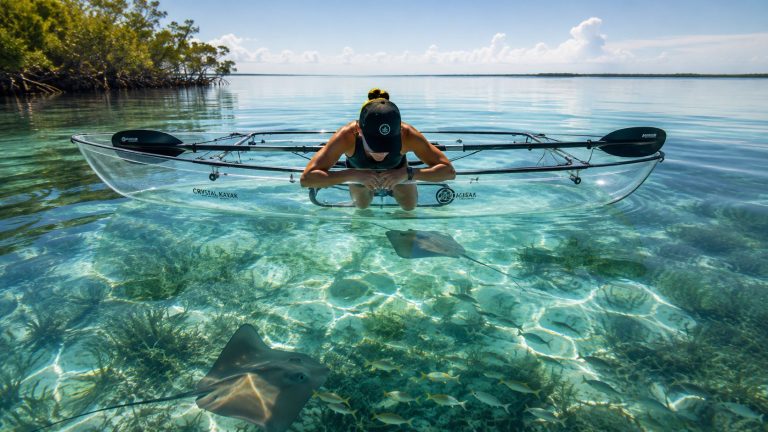
A clear kayak looks simple from shore, but the moment it hits Florida water, the question changes. Not whether the hull is unusual, but whether the day, the water, and the route let it do what people hope it will do. On a calm spring run, over a shallow grass flat, or in a protected bay with clear water, the appeal makes sense fast. On a choppy inlet with glare, wake, and boat traffic, the same boat can feel like the wrong tool.
What It's Like to Look Down While You Paddle
The first time a paddler leans forward in a kayak see through, the reaction is usually the same, a quick pause, then a grin. The hull turns the water into part of the ride, so stingrays, mullet, turtle grass, and the shadow of a manatee don't feel hidden below, they feel close enough to study. That's why the format draws so much attention in Florida, especially when the water is calm and the sun is high.
A transparent kayak is usually a transparent-hull or glass-bottom-style craft built to give that downward view in shallow, high-visibility water. In practical terms, it's made for eco-tourism, nature observation, and shallow-water paddling rather than distance cruising or rough-water work. The boat is doing something a regular kayak can't do as easily, letting the paddler watch what's under the hull instead of only what's ahead.
What the experience really changes
That view changes the rhythm of a short paddle. Paddlers tend to slow down, look more often, and stay in quieter water longer because the point is observation, not covering miles. The appeal is strongest when the bottom is visible and the wildlife is moving slowly enough to notice.
Practical rule: if the water is clear enough to see bottom detail from the seat, the transparent hull earns its keep. If the water isn't clear, the novelty drops off fast.
The key thing to understand is that the see-through feature is about experience quality, not magic. It can make a flat, sunny outing feel special, but it doesn't change the basic nature of paddling. A clear kayak still needs the same attention to water conditions, route choice, and handling as any other small boat.
How a Transparent Hull Is Actually Built
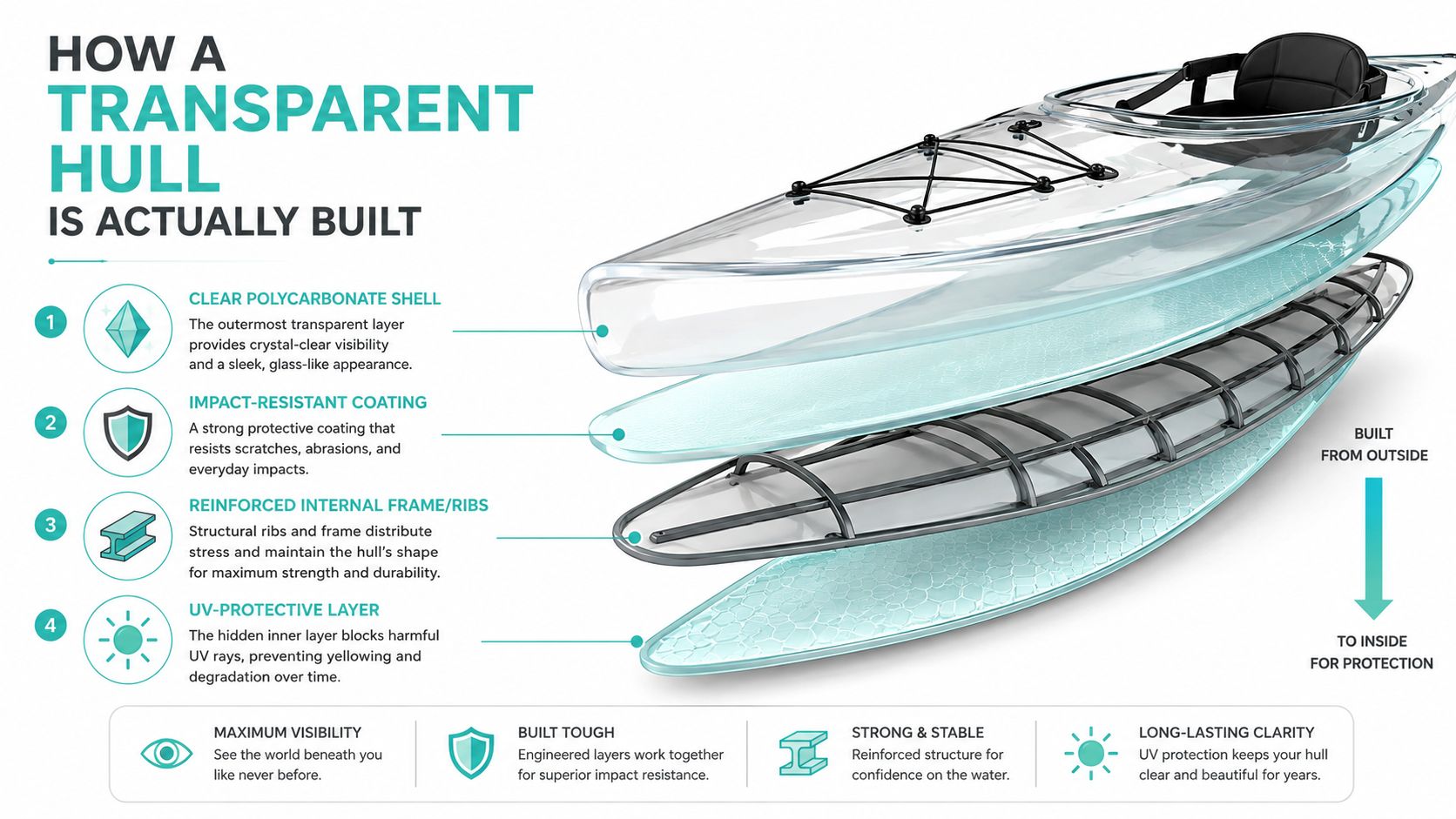
A clear hull starts with polycarbonate, not with the thin plastic people often imagine when they hear “transparent.” The common build uses a 6 mm polycarbonate hull, sometimes paired with an aluminum frame, because polycarbonate gives optical clarity while staying much more impact resistant than glass-like material would be. One commercial specification even pairs that 6 mm sheet with a 40-micron double UV layer to slow yellowing and brittleness in strong sun, which matters in Florida's coastal light.
Why the material stack matters
Think of the hull as a thick, scratch-resistant window, not aquarium glass. The clear panel has to do two jobs at once, let light pass through and survive contact with docks, sand, gear, and the little knocks that happen in normal use. That's why the material choice matters more than the marketing phrase.
A polycarbonate shell does not stay clear by accident. UV protection helps limit aging, and the frame supports the sheet so it doesn't flex more than it should. In hot, high-sun places, that combo is what keeps the boat usable beyond the first season of novelty.
The useful takeaway is simple, a transparent kayak is a material system, not a gimmick shell. The visible part is only one layer of the design, and the frame, coating, and UV protection are what make the boat practical enough for real use. For a deeper look at how product decisions get made around innovation and construction, see PADL's board room perspective on watersport innovation.
Stability, Weight, and What You Can Carry
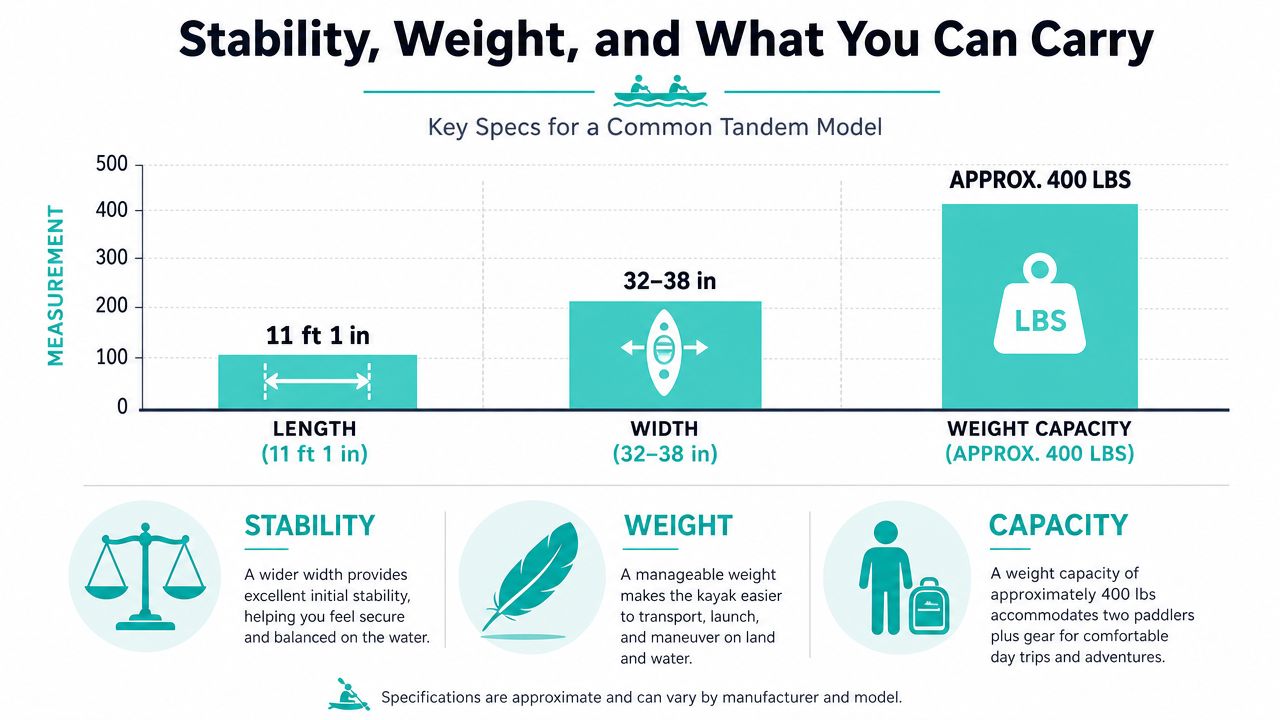
A clear kayak can look delicate from the dock, then feel perfectly settled once you are seated and paddling. The test is how the hull behaves with a real paddler, a cooler, a seat, and the rest of the day's gear. Common tandem models are about 11 ft 1 in long, 32 to 38 in wide, weigh roughly 42 to 62 lb, and carry 385 to 450 lb (source).
What those numbers mean in the cockpit
Width shapes initial stability, the first steadiness you feel before the boat gets moving. In a transparent kayak, that matters even more because paddlers often lean forward to look through the hull and shift their balance while doing it. Wider boats usually feel calmer under you, while narrower ones tend to move faster through the water.
Length changes how the boat behaves once it is in motion. A longer hull usually tracks more steadily, which helps on open stretches, but it is less forgiving in tight turns or crowded launch areas.
| Dimension | What it means for the paddler |
|---|---|
| Length | Longer boats track more steadily, but they are harder to turn in tight spots. |
| Width | More width usually means more stability, especially when leaning to look down. |
| Weight | Lighter boats are easier to carry, launch, and load. |
| Capacity | The number must cover the paddler plus seats, paddle, cooler, and safety gear. |
The printed capacity also needs context. One supplier notes that a nominal 450 lb capacity is more realistically 410 lb in anything other than very calm water (source). That difference matters because advertised capacity is not the same thing as comfortable real-world capacity. A boat can still sit lower in the water, feel slower, or lose a bit of its easy handling once the load starts to stack up.
The simplest way to judge fit is by usable payload. Start with the paddler, then count the extra weight of the seat, cooler, drinks, and safety gear. If the remaining margin feels tight, the boat is already telling you something before you push off.
For a closer look at how paddling setup affects comfort and handling, see PADL's kayaking guidance.
Clear vs Traditional Kayaks for Real Use Cases
A clear kayak earns its place when the whole trip is about looking down and watching the water beneath you. A traditional recreational kayak earns its keep when the day calls for efficient paddling, fewer worries about scuffs, and better performance in rougher water. That sounds simple, but many buyers still mix up the two, because a see-through hull can look like a universal upgrade when it is really a specific tool.
Side by side where it counts
| Dimension | Clear Kayak | Traditional Kayak |
|---|---|---|
| Underwater viewing | Strong in shallow, clear, sunlit water | Limited unless the water is naturally clear |
| Stability | Depends on beam and design, not the clear hull itself | Depends on hull shape and beam, same basic rule |
| Comfort | Good for scenic paddling, not always ideal for long hauls | Often better for distance and general use |
| Durability | Transparent surface can show wear more easily | Usually more forgiving of scuffs and rough handling |
| Maintenance | Needs more care to keep the hull looking clean | Simpler to keep looking used and functional |
| Best fit | Sightseeing, wildlife viewing, content capture | General recreation, distance, chop, mixed water |
The clear option makes sense for a family drifting over a shallow flat, a visitor hoping to watch fish move under the boat, or a photo-heavy outing where the view matters as much as the route. It loses appeal fast for anyone who wants a steady day boat for wind, waves, or a longer crossing. The transparent hull does not make a kayak faster, tougher, or better at hiding scratches, and it does not turn murky water into a viewing window.
The question is simple. Do you want the water below you to be part of the experience, or do you mainly want a boat that handles ordinary paddling with less fuss? If the answer is the second one, a traditional kayak usually fits better. If you are still deciding how that choice fits your own trips, PADL's kayaking guide is a useful place to start before choosing a specialty boat.
In Florida, buy the experience you actually want, not the photo the boat might produce.
Safety and Visibility Beyond the Pretty Picture
A clear hull helps a paddler see down, not out. That distinction matters more than most marketing copy admits, because other boaters still need to see the kayak in fog, dusk, glare, or busy traffic, and the transparent bottom doesn't solve that. Reduced-visibility guidance for paddlers consistently centers on lights, reflective tape, whistles, and conservative route choices, and visibility aids have been shown to help detection in paddler visibility work (source).
What still has to be carried
A paddler should treat the clear hull as an underwater viewing tool, not a safety device. The safety checklist stays the same regardless of hull type, especially when the route crosses areas with mixed boat traffic or changing light.
- Lights: Use them when visibility starts to fade, because surface visibility drops fast near dusk.
- Reflective tape: Add it where it can catch attention from approaching traffic.
- Whistle: Keep a simple sound signal within reach, not buried in a dry bag.
- Route choice: Stay conservative when fog, wake, or traffic make the water unpredictable.
Florida makes this especially important. Fog, dusk outings, and mixed traffic around places like Tampa Bay, the Intracoastal, and busy inlets can turn a calm-looking paddle into a visibility problem. A clear hull does nothing to change that.
The better mental model is this, the boat may improve the view under the hull, but the paddler is still responsible for being seen on the surface. For more safety-centered planning, PADL's kayak safety resources are the right companion to any transparent-kayak outing.
Where Florida Water Makes the Format Worth It
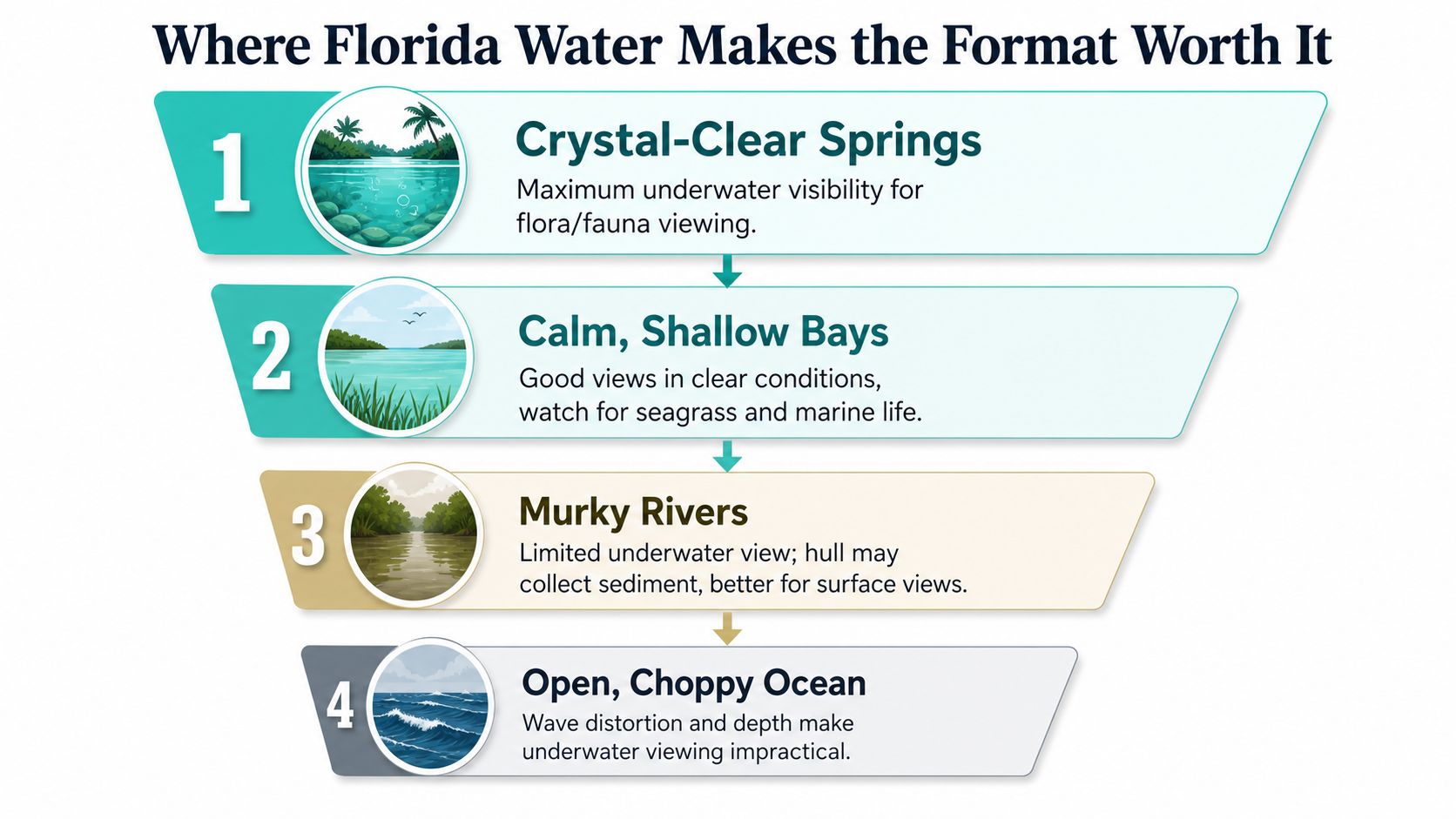
The transparent format shines where the bottom is visible and the water stays calm enough for the viewer to notice what's below. That means Crystal River springs, the Gilchrist Blue Spring area, shallow grass flats in the Keys and around Tampa Bay, mangrove tunnels with good light penetration, and protected bays with sandy bottoms. These are the places where the hull can do what it promises.
Read the water before picking the boat
Water clarity matters more than the boat itself. So does sun angle, because a low glare-heavy angle can wash out the view even in decent water. Wave action matters too, since chop breaks up the line of sight and makes any under-hull viewing less satisfying.
The weak fits are just as important. Choppy open Gulf or Atlantic water, surf zones, and tannin-stained rivers reduce the payoff quickly, and in those conditions the transparent hull starts to feel like a novelty rather than a feature. The same goes for shallow spots with stirred sediment, because the clearer the boat is, the more obvious it becomes when the water isn't.
For readers who want to pair the outing with wildlife watching, a field guide can help after the launch. A useful companion is this Caribbean fish identification guide, especially when the goal is to recognize what's moving under a clear hull without guessing from a distance.
Guided clear-kayak tours already operate in several Florida destinations, and that's usually the easiest way for a beginner to test the format without hauling a fragile boat around or worrying about storage. For a paddle focused on mangrove scenery and protected water, PADL's mangrove kayaking tours fit the same style of trip planning.
The best clear-kayak day in Florida is usually the one with the clearest water, not the fanciest boat.
Choosing Your Next Step on the Water
The simplest decision framework comes down to use case. Book a guided clear-kayak tour if the goal is to try the underwater view once or twice with no logistics. Rent a clear kayak for a self-paced day if the route is calm, shallow, and visually interesting. Skip the transparent hull if the priority is distance, chop, or a boat that can take rougher handling without babying the surface.
A quick checklist before choosing
- Water clarity: If the bottom won't be visible, the format loses its main advantage.
- Sun angle: Bright, direct light usually helps the view more than overcast conditions.
- Visibility kit: Lights, reflective tape, and a whistle still matter.
- Payload: Count the paddler plus every item added to the boat.
- Use case: Sightseeing and wildlife viewing point one way, rough-water paddling points another.
That's where the transparent kayak fits best, as a special-purpose experience boat rather than a universal upgrade. For Florida readers who want to rent without overthinking the setup, PADL's rental guide is a practical place to start.
If a clear kayak sounds like the right fit for a spring run, a mangrove paddle, or a calm-water family outing, PADL can help make the day easier to plan. Browse the options, match the boat to the water, and choose the kind of Florida paddle that fits the route instead of the social-media version of it.